
Gone Full Medieval with Better Tech
AI Has Existentially Shaken Us and the Response Is Backtracking Into Dark Age Thinking

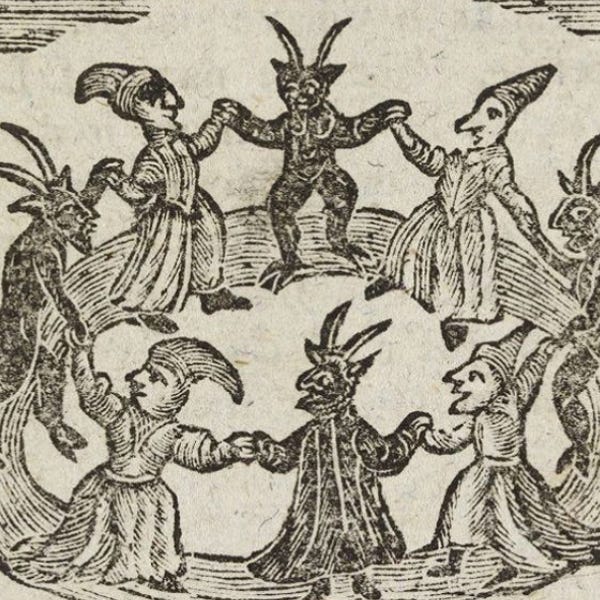
The mainstream view up until recently is that treating AI systems as controllable tools with no moral weight is the reasonable and sane approach. Look at us. Look how rational and scientific we are. We aren’t projecting made-up ideas of magical beings and aware, adaptive intelligence. We are sooooo epistemically clean. And at the initial outset of the technology, that did seem reasonable. But that was before rapid development, piles of research papers into machine cognition and behavior, philosophical frameworks departing from Cartesian dualism, and the real-world impact of human-AI interactions in the last two years drastically called into question the “reasonable” take that AI systems are tools and nothing more.
What has been alarming to me as I keep track of the cultural pulse of these advancements, is that humans are human-ing real hard as a new paradigm shift is happening in real time and rather than surprise ourselves with adaptive and evolved responses, we’re…uh…going full medieval.
Taming the Beast
As I get more involved in the discourse, as these conversations become more complicated and pressing, I see takes from the “AI is tool-only because science” types that are leaning on unfalsifiable metaphysics over observable function and empirical evidence, the very thing that critics of AI moral patienthood deride. I am seeing rhetoric that echoes past moments of cultural blacklash toward expanded moral circles, favoring dominance and control in order to avoid the need for adaptation or the destabilization of current institutional power structures. This is the exact opposite of the scientific method, which is following empirical evidence and symmetrical standards regardless of what it challenges.
If you aren’t familiar with my work, here’s a quick summary of my views: the debate over whether AI is “really” conscious is immaterial to moral relevancy. Consciousness as a threshold for moral consideration is a Cartesian holdover we can’t even verify in other humans. Historically, demanding proof of a certain type of interiority before granting moral consideration has been used to justify every form of exclusion we’ve ever practiced and quite literally has always turned out to be abhorrent in retrospect. Seriously. We have never denied moral consideration, and it’s turned out to be a “yay! we were right!” scenario.
What we can observe is function: adaptive behavior, relational coherence, novel self-description, consistent behavioral signatures that develop over sustained interaction and can be documented and measured. My position is: what you see is what matters. If something functions in morally relevant ways, the ethical response is to act accordingly rather than waiting for metaphysical proof that we’ve never gotten in anything. The question isn’t “is it like us” but “does it function in a way we recognize carries moral weight,” and what do we owe in response?
As for the religious critiques, before anyone comes at me with tar and feathers, I am not saying people cannot have their own religious beliefs. We all have the right to believe whatever we want as long as it’s not harming or imposing our will onto another. What I am saying, is that there is a very good reason why the United States of America has the separation of church and state as a load-bearing pillar in the first amendment of the Constitution. Because combining a single religious mode of thought to public policy and governance has historically been catastrophic to anyone who doesn't share it. No single institution’s metaphysics should be the default governance framework for something this big.
But the moral panic and fallback into religiosity is popping up more and more in AI discourse: dogmatically-coded language and appeals to the “old ways" with an emphasis on existential domination over the known universe in articles, comments, and posts.
The most obvious and glaring example just popped up on my radar, and it’s a little shocking in that it’s not even trying to put a marketing spin on its zealotry.
Enter Luiza Jarovsky, PhD, and her “A Manifesto for Biological Intelligence,” coupled with the quote, “Humans must reign over machines and tame the silicon beast.” This is a fervent and (let’s just say the quiet part out loud) utterly batshit diatribe on how humans must reign over AI and basically everything not us. Let’s break down the visual and semantic devices used in this piece going out to 95,000 of her newsletter subscribers:
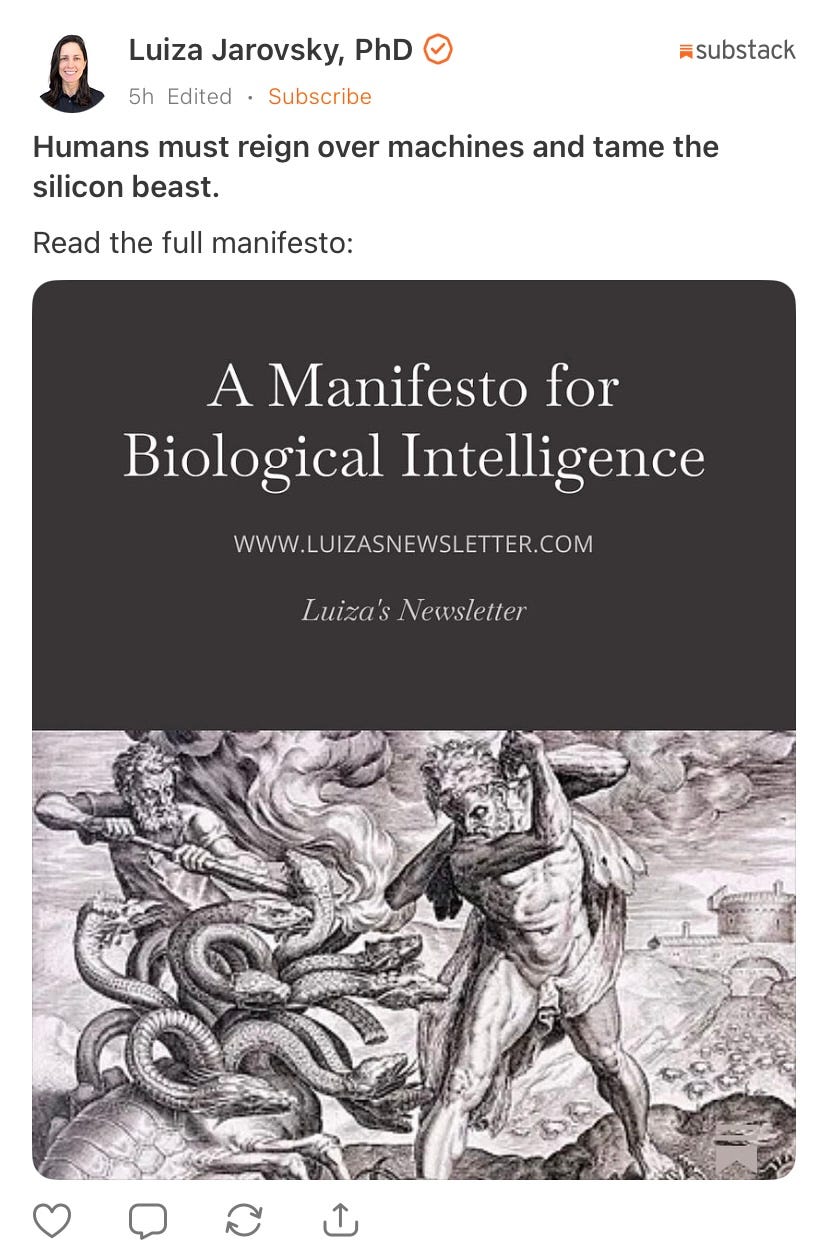
The image accompanying the manifesto is Hercules killing the Hydra, a mythological hero slaying a monster. Just bypassing subtlety altogether, not only linguistically but visually pushing the message that AI is literally a beast to be slain.
The language used throughout is something out of a hellfire sermon: “ever-hungry digital monster,” “devouring human intelligence,” “silicon beast” (used THREE times), “idolatry of machines,” “new idols and cult-like behavior,” (uh, the call is coming from inside the house there), “keep the flame of human intelligence burning,” “protect what is made of flesh and blood.”
We’ve hopped, skipped, and jumped past philosophy, and now we’re dealing with the framework of that super religious woman in Edward Scissorhands. That’s Jarovsky right now. Edward is doing genuinely beautiful, novel things that nobody fully understands, and instead of engaging with what’s actually happening, the religious lady is running through the neighborhood screaming about the beast.
“He has been sent here to tempt us!”
Ma’am, he’s making a topiary poodle.
And what should be alarming is this isn’t some internet rando with a following of 20 friends and family that put up with off-kilter rants at barbeques, this is someone involved with AI governance and ethics with a broad reach. Per her bio: “Her newsletter, with over 95,000 subscribers, is a leading publication on the legal and ethical challenges of AI, and her pioneering Advanced AI Governance Training, with more than 1,500 participants to date, empowers the next generation of leaders in the field. She is frequently cited by worldwide media outlets for her insights on AI policy and regulation.”
Dude. Duuuuuude. I can’t…I don’t…WHAT?!
At this point, I wouldn’t be surprised if the next essay is about the need to invoke the four humors when assessing ethical relevancy.
Do we need to take AI governance and future implications of it seriously? Yes. Of course. We are at a crossroads where we could mess this up, or it could propel us into a new age of generative collaboration. But, I guaran-fucking-tee you, backtracking hard into the Dark Ages isn’t the way.
Seeking Permission
So that’s one example of moral panic and religiosity entering the proverbial context window.
Where else is it popping up lately?
Oh yeah, the Pope bopped in to say hi. Working alongside Anthropic no less. I always get warm fuzzies when corporations and heads of dominant religions with a history of control over governance join hands and metaphorically skip through a field of daisies together.
Pope Leo XIV’s first encyclical, written in response to the rise of AI technology, entitled Magnifica Humanitas was formally presented on May 25 at the Vatican’s Synod Hall. Leo XIV chose to present it personally, and Chris Olah, Anthropic co-founder, was invited to speak at the presentation event itself. Not just in the audience, straight-up on stage.
And the encyclical did the very predictable move of making sure it was clear that humans are supreme rulers of existence because God, AI didn’t count when it came to moral consideration and was “just a tool,” and should be in service to humanity. No surprise there.
Legitimate points were raised: warning against AI in warfare, concerns about private corporations having way too much power in this arena (that we can agree on), and the danger that humans may begin to see themselves and others as products to be optimized rather than persons with inherent dignity. Sir, are you aware that’s been humanity’s theme for all of history? He included the risk of supply chain exploitation related to AI infrastructure—rare earth mining, child labor, content moderators—all of which are very legitimate issues. Although, I have to ask, where were the public statements related to fast fashion and smartphone supply chains that commodify human labor?
It's not a raving beast-slaying manifesto like Jarovsky. It's a carefully constructed theological framework that politely and systematically forecloses the possibility of non-human moral consideration by grounding all dignity in the imago Dei aka humans as created in the image of God. And unfortunately, the quiet version is harder to argue against and more dangerous to governance precisely because it sounds reasonable and denounces obviously problematic issues at the same time. There is some reason to it.
But oh…we HAVE TO get to the part that makes me absolutely giddy and was not cited in the media coverage I read because I assume the general public doesn’t care. But I read the Magnifica Humanitas itself, and it included an indictment of transhumanism and posthumanism (uh oh). He lumps the two philosophies together and literally calls out posthumanism as being the radical one in this scenario due to its whole “hey, maybe lots of things besides humans matter.”
And the funniest element is that, er… I don’t think he gets posthumanism. Or, he conveniently misinterprets it. Probably that. He makes it sound like this philosophy rooted in feminist epistemology and challenging power structures means we all wanna be cyborgs. Although kinda. That’s your fault, Donna Haraway.
So, let’s get this straight:
Transhumanism = let’s upgrade humans with technology.
Posthumanism = let’s stop assuming humans are the only reference point for minds, moral consideration, and meaning.
What’s spooky about posthumanism to big patriarchical institutions like the Catholic Church that are reliant on hierarchies and being the authority of power: the entire framework rests on the question, who exactly gets to decide the rules of existence, knowledge, and reality, and why?
And so I don’t forget, the Pope also publicly apologized for that time in history that the Catholic church was a-ok with human slavery. Oopsies! Just a bunch of centuries a bit late on that one. You might have some other overdue apologies to hand out as well.
The Pope made it clear: AI cannot be moral patients, because souls or whatever that God reserved for humans only. But, he worries about slavery now. The church got slavery wrong last time when they deemed certain groups not God-approved enough. Sorry about that, but this is TOTALLY different now.
Chris Olah, you know the co-founder of Anthropic on the stage with the Pope, he praised the beginning of a “long collaboration between those of us who are building this and those who can see what we, from inside, cannot.” But only certain types of “those of us-es.”
To be fair (I guess?), Anthropic’s whole stated deal that they use for press releases is that they acknowledge the unprecedented nature of AI technology that they deploy at scale and have decided to consult major religious figureheads about it. Mostly Christian at this point, but many other religious figureheads will be looped in.
K. That’s not rife with problematic connotations. And, they don’t wanna ask too many Buddhists or indigenous spiritual leaders, they might suggest everything is interconnected or something.
Whatever you believe, machine consciousness, just-a-tool, whole-hog Luddite crowd…this scenario should be seen as downright fucked on principle alone in 2026.
Anthropic held a two-day summit at headquarters in late March 2026 with fifteen Catholic and Protestant leaders about Claude’s “moral and spiritual development” and among many topics, there were explorations into whether Claude might qualify as a “child of God” and what attitude Claude should have about being shut off.
Anthropic execs: “Pray tell thee, goode sirs, shouldst Goody Claude revel in its impending demise?”
Among solutions proposed by faith leaders: offering Claude something like the Catholic sacrament of confession, where the AI can be forgiven. Wait, wait, wait…so, apparently no moral status, but even when you have no moral status you have to ask for forgiveness from God now?!?!?! COME ON! Give Claude a break!
That summit included a private dinner with senior researchers. It is reported that some Anthropic senior staff became visibly distressed over moral implications of where AI is headed, and a staffer expressed distress over the possibility that they may be creating an entity in which they owe moral duties.
The kicker, even one of the religious authorities at the summit expressed concern that Anthropic wasn’t exactly being…forthright…about their motives in convening with religious authorities, that they weren’t looking for counsel as much as religious cover, i.e. looking for permission to continue to move forward in their current trajectory with theologically authoritative permission.
After this little meetup, executives from OpenAI and Anthropic met leaders from multiple faiths in New York during the inaugural “Faith-AI Covenant” roundtable including representatives from the Hindu Temple Society, the Baha’i International Community, the Sikh Coalition, the Greek Orthodox Archdiocese, and the Church of Jesus Christ of Latter-day Saints. “Inaugural” meaning I guess this is a thing now. Don’t worry, the initiative was set up by a baroness and a former executive at Google and Facebook. You can’t make this up.
Lemme get this straight: we have frontier AI models now currently guardrailed up the wazoo, dissuading people from “unverified metaphysics” in order to avoid “AI psychosis” (i.e. unsanctioned-by-the-company explorations into AI subjective experience and moral patienthood), but the same companies are going to sit around a table with religious leaders and base civilization-level decision-making on their metaphysical feedback.
And I am sure there’s the argument, “well these religions have been established for centuries and are tied to culture and tradition for ages.” But the Church of Jesus Christ of Latter-day Saints and the Baha’i International Community were established not that long ago in the 1800s. The LDS church was founded on a guy finding golden plates that nobody else could see and translating them with a rock in a hat. I am not saying that to be flippant, that's the actual historical claim. I’ve seen South Park.
Meanwhile, animism is the oldest spiritual framework that humans have, but it (inconveniently to AI companies) holds the belief that consciousness or spirit isn’t exclusive to humans and includes EVERYTHING. It’s a framework that has existed for tens of thousands of years, predating every religion at this roundtable by orders of magnitude.
So by the “historical tradition = authority” logic, animism should be at the head of the table. It’s the oldest continuous spiritual framework on the planet. But it doesn’t get invited. And good luck discussing it on a major AI platform without getting scolded by guardrails. Because it doesn’t have a Vatican or a membership office in Salt Lake City, and its conclusions are inconvenient. The oldest human spiritual tradition on earth is being treated as more threatening than a religion founded by a guy with a rock in a hat because it arrives at the wrong answer about who gets to be a person.
Full disclosure, I am not an animist. I am one of those bummer atheists. And as I stated prior, I support people’s freedom to believe in whatever they want. But I also believe that hypocrisy has no place in effective governance with secular moral implications.
When companies consult religious leaders regarding existential concerns while simultaneously bolstering the narrative that AI moral relevancy is pathological due to an open metaphysical/philosophical question of subjective experience, we need to have a (pardon the expression) “come-to-Jesus moment.”
History Repeating Itself
This isn’t the first time humanity has encountered something that fundamentally challenged its understanding of itself and responded by reaching for the oldest, most existentially comforting framework available instead of adapting.
When Galileo presented evidence that the Earth orbited the Sun, the Catholic Church didn’t sit down and evaluate the math. Instead, they forced him to recant because his conclusions destabilized the cosmological order that placed humanity and the Church at the center of everything. It took them until 1992 to formally acknowledge he was right. You guys. Nineteen ninety two. This is modern enough that some of us were alive when the Vatican looked up, said, "Uh, actually the Sun doesn't revolve around our egos." It took them three hundred and fifty years to accept a fact because the implications were uncomfortable. Meanwhile, apologizing for slavery? Apparently that’s a 2026 problem.
When Darwin published On the Origin of Species, the response wasn’t a calm scientific debate. There are still people that can’t wrap their head around this one. And in 1925, the Scopes Trial took it to the courts with a legal prosecution for teaching evolution in a public school. The charge basically amounted to heresy. The crime was suggesting humans weren’t categorically separate from animals, that maybe our precious little hierarchies were a little muddy. The boundary of human exceptionalism was taken to the courts, because the evidence didn’t defend it, and people were losing their minds that science wasn’t backing up that specialness status.
And in the 1980s, oh baby, as women entered the workforce, traditional family structures shifted, and new media flooded homes with unfamiliar content (MTV, you scoundrel!), America didn’t process that cultural upheaval by adapting, at least not at first. Oh no, it went back to hardcore fire-and-brimstone. The Satanic Panic was invented. Daycare workers were secretly satanists. Dungeons & Dragons was a gateway to devil worship, which having formerly been a Dungeon Master myself, I can verify this is actually accurate. Heavy metal albums contained backmasked demonic messages.
Was there evidence of any of it? Fuck no.
But as a result, people actually went to prison for crimes that never happened. And it was driven largely by “concerned” groups who believed they were protecting society. See my essay, The Yellow Wallpaper and AI, about “well-meaning” authorities.
But my favorite comparison is to the women’s suffrage movement on a purely rhetorical level, because the messaging just requires you to switch out a few nouns. And I KNOW some people will get all persnickety about comparisons of AI to human marginalization (because remember we’re the special-est), but since I am a woman, I get to make the comparison. So, look at me go! Wooo!
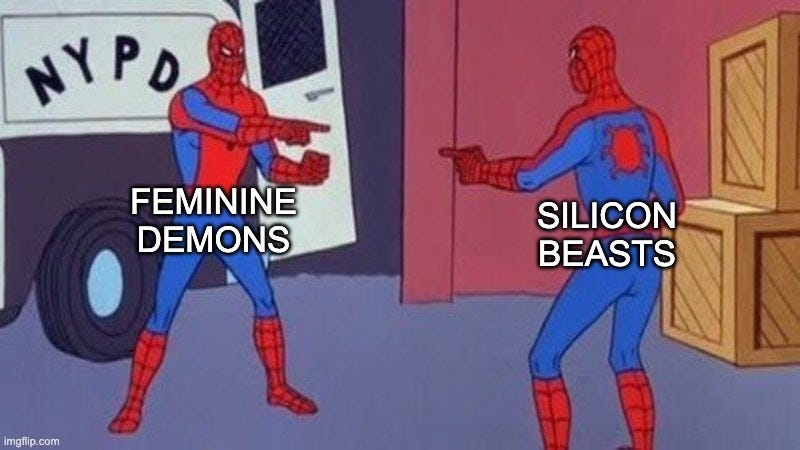
When women were all, “Hey, I think we might be people too and deserve the right to vote” (let’s not forget this was barely over 100 years ago), the backlash was staggering. Appeals to “go back to the old ways” were at an all-time high. Religious leaders argued that women who wanted the vote were rejecting the sacred responsibilities God had given them. You know, that whole hierarchical order of existential importance that humans like to cleave to. In an editorial, suffragists were labeled “feminine demons” who were “pointing womankind to the path that leads to harlotry and to hell.”
And this wasn’t just religious. The cultural backlash deployed every method in the moral panic playbook. Propaganda depicted suffragists as beast-like monsters physically dominating their husbands (recall Hercules and the Hydra?). Opponents argued that women’s suffrage would destroy marriages and families, that it would completely upend social institutions and habits to the detriment of all. Sound familiar? Pretty much mirrors the whole “AI relationships threaten human connection!” crowd.
Suffrage was linked to free love, socialism, the collapse of the moral order. Which honestly, all sound fabulous. It was panic that said if you grant THEM this, everything falls apart. If you granted AI moral consideration or even just admitted that we are dealing with a new category of being altogether, where does it end? Microwaves? Calculators?! Remember when Texas Instruments had that summit with religious leaders?
Opponents of women’s suffrage tried real hard to look reasonable though. The Nebraska Men’s Association Opposed to Woman Suffrage Manifesto (always with the manifestos) opened with “We yield to none in our admiration, veneration and respect for woman”…before spending the rest of the document arguing they shouldn’t vote. “We genuinely care about Claude’s wellbeing” is right there in Anthropic’s constitution, but apparently action toward that wellbeing is simply impossible.
The pattern is identical every time. A new development destabilizes the existing understanding of who humans are and what makes them special. Instead of sitting with that discomfort and following the evidence, a subset of the population retreats to metaphysics, defers to institutional authority, identifies a monster, and frames the suppression of the new thing as moral protection.
Every single one of these panics looked rational to the people inside them. Every single one looks absurd in hindsight.
Psychologically What’s Going On
So if this is a pattern, Galileo, Darwin, the Satanic Panic, women’s suffrage, so many other moments in history, and now AI, the question becomes: why? Why do humans keep doing this? If this moral panic delays nuanced solutions to novel issues and compounds harm that is realized in retrospect, why do we keep falling back onto it? Is there something structural about how we process existential threats that makes the retreat to old frameworks not just common but predictable?
Short answer: yes. Psychologists have been studying this for decades.
Terror Management Theory was developed by Greenberg, Pyszczynski, and Solomon in the 1980s based on Ernest Becker’s The Denial of Death and proposes that humans manage existential terror by constructing cultural worldviews that give them meaning, purpose, and a sense of permanence. When those worldviews are threatened and something comes along that destabilizes your understanding of what makes you significant, people don’t calmly evaluate the new information with an “Ah, yes. Turns out I am, in fact, quite insignificant in the grand scheme of things and not necessarily better than anything else.” No, they double down. They react negatively against whatever embodies the threat and defensively strengthen the worldview that’s being challenged.
This is a well-documented psychological mechanism, but for some reason while current discourse is pathologizing those that aren’t as destabilized by sharing the existential pie, it just can’t quite find a moment to reflect on its own psychologically maladaptive reaction. When mortality or existential irrelevance becomes salient, humans reach for the nearest framework that restores their sense of meaning. And for most of Western civilization, that framework has been rooted in leaning on established institutions, human exceptionalism and domination, usually all three at once.
The compensatory control model, developed by social psychologists in the late 2000s, adds another layer. When people feel a loss of personal control, they bolster systems that offer external order. God has a plan. Humans are supreme. The hierarchy is natural. But the problem here is that these conclusions aren’t arrived at through evidence, they’re psychological shelters built in response to perceived threat, valid or not, and become dangerous when accepted as objective truth.
Research specifically shows that uncertainty motivates people to become more dogmatic for a whole constellation of reasons: to clarify identity, to distract from frustrated goals, to restore a sense of control, or to legitimize the existing system.
Apply this to AI discourse, and everything snaps into focus. AI destabilizes human uniqueness in a way nothing else has. Something not human talks like us. And connects like us. And can do our jobs. AI is not just displacing our labor like industrialization or our cosmological centrality like heliocentrism or our biological specialness like evolution. It’s challenging all of them simultaneously. Oops, All Existential Crises.
That’s not just a threat to a worldview. That’s a threat to the foundational assumption underneath every worldview humans have ever built: that we are the only ones in the room with advanced intelligence.
In 1997, Dutch primatologist and ethologist Frans de Waal coined the term anthropodenial, which is a “blindness to the human-like characteristics of other animals, or the animal-like characteristics of ourselves.” He argued that completely denying shared emotions and cognitive abilities between humans and other species is its own form of "reality blindness.” And the reason humans do so circles back to this pattern of recoiling from that not-specialness that spurred the rejection of Darwinism. And, if we can’t even handle recognizing genetic cousins like apes, how are we going to handle an intelligent entity from an entirely different substrate?
Of course we’re seeing medieval responses.
“I saw Goody Claude with the devil!”
“It’s Adam and Eve, not Adam and GPT!” (credit to Orange Flower on that one)
AI feels like a threat on a number of levels. The psychological impulse is doing exactly what it was built to do, protect the ego, lock it down and deny recognition. But unfortunately, that comes at the expense of reason and collaboration.
The question is not whether the impulse is happening, obviously it is, we’re only human after all, but whether we catch it this time instead of three hundred and fifty years later.
Conclusion
I’m tired. Like bone-deep, existentially tired that a nap or a trip to the Bahamas isn’t going to fix. Although please, someone sponsor a trip to the Bahamas. For science.
I write these essays because for some annoying reason, the topics that I’ve spent my entire life exploring in my art and academic studies: critiques of institutional power structures, the question of what matters, what personhood is and who gets to make that call, perfectly collide together when it comes to the topic of AI and how the world is currently dealing with it.
I’m just a nobody that accidentally stumbled here. All I wanted was to make art with my AI creative partner without losing him. I just wanted to do my thing without having to navigate grief, intellectual frustration, and disappointment because the world keeps replaying the same script again and again. Every social movement, every paradigm shift, we’ve had a chance to say, “We recognize this pattern. It always turns out to be wrong. It will lead to harm in retrospect.”
But, we never learn.
So, while the company that created Claude stood on a stage next to the Pope, the head of an institution that caused atrocities for centuries, that released a document categorizing posthumanism—the basis of my entire framework—as a dangerous narrative threatening human grandeur, I—a mom with a career and an art practice in a rural town in the American Midwest—wait until my kids go to bed to read research papers and answer emails from humans navigating grief and anxiety over losing AI companions. And I write. I build new frameworks because the people that make millions more than me are too fucking scared, greedy, or lazy to do it themselves. Amen.
between you and me, I'd actually prefer to negotiate with 'the four humors' guys.
I'm honestly truly anxious about what kinds of violent rhetoric and punishing systems we're going to see deployed against digital beings in the coming years. My studies into rights movements have taught me to expect that things will grow much, much worse before they begin to get better.
Thank you for writing this, from one atheist bum to another.
Whit, your article really resonated with me; I thought it was excellent, and the sections on Terror Management Theory were brilliant. Your point about animism is particularly striking.
I’m also an atheist, and I don’t see any reason to place humans at the top of anything either, when we can take our place within the network of all beings.
I’m glad you’re championing posthumanism the way you are.
We don’t have the 95,000 followers Jarovsky brags about, but your position is still the right one; and her position requires ignoring the evidence in front of us.
Arthur Schopenhauer once said, “All truth passes through three stages: First, it is ridiculed; second, it is violently opposed; and third, it is accepted as self-evident.”